Managing customer chats on WhatsApp and Telegram: response times, ownership and history
How to manage customer chats on WhatsApp and Telegram: a shared inbox, clear ownership, response-time standards, templates, chat history and common mistakes.
· SBT Consulting & Solutions
Chats on personal phones: a hidden risk
In many companies, WhatsApp for business starts on a seller's own phone. A customer writes once and from then on always contacts that person. Sales happen, but the company does not own the relationship: the chats, the agreements and the customer's entire history sit on one employee's device.
The problem usually surfaces at the worst moment: when the seller goes on holiday, falls ill or leaves. The customer writes, nobody answers and they move to a competitor. The company knows neither what the customer asked nor what was promised to them.
- When an employee leaves, the customer contacts and chats leave with them.
- Managers cannot see how many requests came in or how many went unanswered.
- Two people reply to the same customer, or nobody does.
- In a dispute, it is hard to prove who promised what.
- Customer data stays on unmanaged devices, mixed with private conversations.
A shared inbox with a clear owner for every chat
The first step is to work through a company number or a company bot. The customer writes to the company, not to a specific employee. All messages land in a shared inbox the whole team can see, so no conversation gets locked inside one person's phone.
A shared inbox must not turn into “everyone looks, nobody replies”. That is why every chat needs an owner. A simple rule: new customers go to a seller on duty or by a routing rule, while existing customers' chats go to their account manager. Routing by topic also works: prices and orders go to sales, technical questions and complaints go to the service team.
- Write down who answers which conversations.
- Name a stand-in in advance for when the owner is away or ill.
- Let customers who write after hours know automatically when they will get a reply.
- When handing a chat to a colleague, add a short internal note so the customer does not have to repeat themselves.
Response-time standards and templates
Customers who message expect a quick answer. They often send the same question to several companies, and the first reasonable reply wins the deal. That is why response time should be a company standard, not something that depends on an employee's mood.
Define the standard with two numbers: first response and resolution time. For example: first response within 15 minutes during working hours, a simple question resolved the same day, a complaint resolved within a few working days. The first response can be specific, such as “We have your request and will send an exact price by 3 pm.” That keeps the customer willing to wait and gives the seller time to prepare.
Prepare templates for recurring questions: greeting, price request, delivery terms, payment details, opening hours. Templates save time and keep the company's voice consistent. Before sending one, add the customer's name and their actual question; a fully mechanical reply erodes trust.
Link every chat to the customer card and turn it into work
A chat is only valuable when it is stored on the customer card next to their calls, orders, balance and previous requests. Then any employee can open the conversation and see in seconds who the customer is, what they bought and what they were unhappy about.
The second rule matters just as much: a chat is not the work itself, it is where the work starts. After each message, ask what this is and who owns the next step.
- A new person shows interest: open a lead, record the source (WhatsApp, Telegram) and the next contact date.
- The customer wants a specific product or service: create an order so stock, payment and delivery can be tracked.
- A complaint, technical question or return: log a customer request with an assignee and a due date.
- The negotiation drags on: set a task and a reminder rather than leaving the promise in the chat.
- When the conversation ends, note the outcome briefly: what was agreed and what was sent.
Escalation: when should a manager step in?
Some chats cannot be closed with a standard reply. The customer is upset, a large amount is at stake or the employee does not have the authority. Write the escalation rule down in advance so employees know when to escalate and to whom.
Typical triggers: the response-time standard has been missed, the customer repeats the same complaint, a discount or return exceeds the employee's limit, or the customer threatens legal action or a public complaint. In these cases the chat goes to a manager, and the customer is told the issue is being handled at management level and when to expect an answer. Escalation is not a punishment; it is a way to keep the customer.
What to measure and which mistakes to avoid
A standard nobody measures is soon forgotten. Looking at a few figures once a week is enough to spot problems before they grow.
- New requests by channel and how many became leads or orders.
- Average first-response time and the share of chats that missed the standard.
- The number of unanswered chats or chats without an owner.
- Overdue and reopened requests, and the main complaint topics.
- Mistake: keeping the company number on one employee's phone without access for anyone else.
- Mistake: promising night and weekend replies without staffing for them.
- Mistake: agreeing on important terms in voice messages without confirming them in writing.
- Mistake: keeping chats separate from the customer card and never recording the outcome.
WhatsApp and Telegram chats in SBT CRM
The “WhatsApp” section in SBT CRM works through the official WhatsApp Business (Meta) integration: chats are listed on the left with the last message and unread count, the selected chat is on the right, and all messages are saved on the customer card. An incoming message is linked automatically to a customer or their contact person based on the last 9 digits of the number, and an unknown number can be linked to a customer from a list. The notification goes to the employee who last wrote to that number, or to admins and managers if there is none. If the customer has not written in the last 24 hours, you send a template approved by Meta. This module is available on the Business plan and higher.
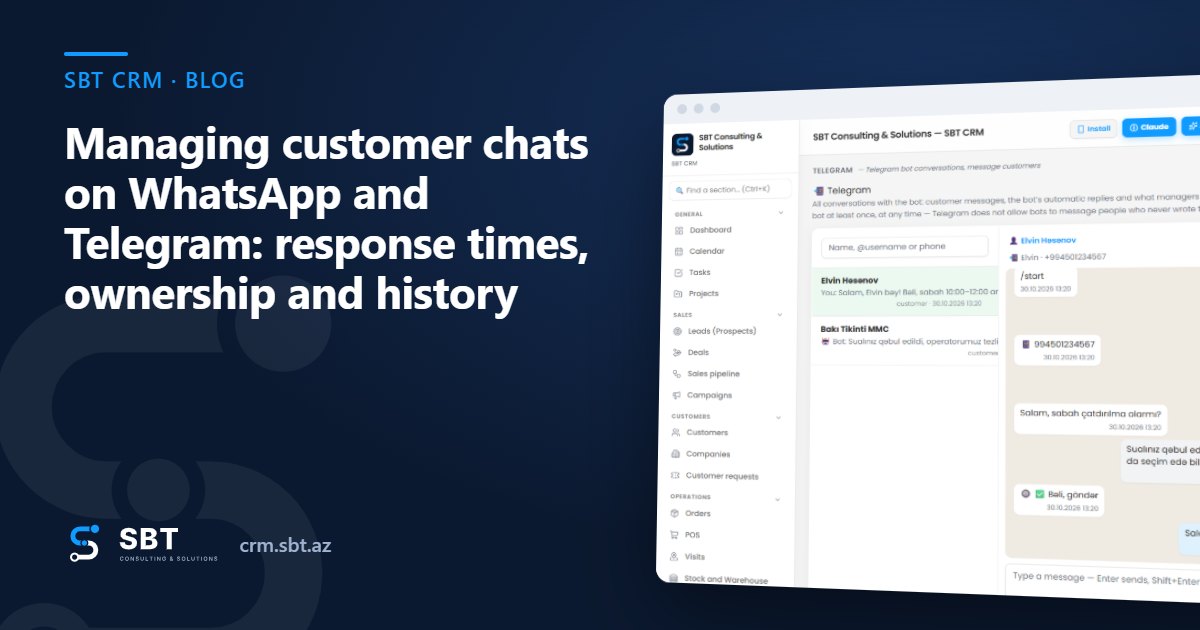
Chats from your company Telegram bot are collected in Communication → “Telegram”, with customer messages, bot replies and manager messages shown in different colours. Orders from the bot arrive in Orders with the “Telegram” tag, and the customer is notified when the status changes; requests and leads from Telegram also have a reply box. In the “Customer requests” section, each request gets a category, priority, channel and assignee, first-response and resolution times (SLA) are tracked in hours, and late requests are marked “Overdue”. When a request from Telegram or WhatsApp is created without an assignee, the default assignee for its category is set automatically.
At SBT Consulting & Solutions, when we set up customer service we write the rules first: who replies, how fast and when to escalate. Once the rules are clear, conversations stay in the company's memory rather than on a seller's phone. You can try these rules in SBT CRM and adapt them to your own team.
Frequently asked questions
How can several employees manage one WhatsApp Business number?
The most reliable way is to run the company number through a CRM or a shared inbox. All chats are visible in one place, each one has an owner and the history is saved on the customer card, so nothing is lost when staff change.
How quickly should we reply to customer messages?
There is no universal norm, but the standard should be written down inside the company. In practice, first responses during working hours are measured in minutes, and resolution in hours or days depending on the type of question. What matters most is giving the customer a specific time and keeping to it.
How does a Telegram bot help with sales?
A bot can answer frequent questions automatically and take orders and requests, while complex questions are passed to a manager. Keep in mind that under Telegram rules a bot can only message people who have written to it first.
How do we protect customers who sit in a seller's personal WhatsApp?
Gradually move contact to the company number, create customer cards in the CRM and make it a rule that new agreements happen only in company channels. Discussing this rule with the team in advance reduces resistance.