How to design a sales commission and bonus plan: percentages, targets, returns and profit
How should you pay sales staff? Commission on sales, payments or profit, targets and tiers, deducting returns, caps, and the most common bonus plan mistakes.
· SBT Consulting & Solutions
Base salary vs bonus: finding the right balance
A salesperson's pay usually has two parts: a fixed base salary and a variable part that depends on results. The base provides stability and pays for the work around the sale: customer service, paperwork, reporting. The variable part rewards results. If the base is too large, the bonus stops motivating anyone; if it is too small, people chase quick deals and avoid customers with long buying cycles.
The right mix depends on how you sell. With short sales cycles where results depend directly on individual effort, the variable part can be larger. Where selling involves long negotiations, technical advice and teamwork, the base should carry more weight. Purely as an illustration: a base of 800 AZN and an expected bonus of 400–600 AZN when the target is met. That ratio is not a rule, just a starting point for discussion.
What to pay on: sales, payments received or profit?
Choosing the base is the most important decision in the whole plan, because that is the number your salespeople will try to grow. Each option has its own strengths and risks.
- Sales (revenue): simple and easy to understand, and the salesperson sees results immediately. The risk is that people ship to customers who may never pay, or buy volume with heavy discounts.
- Payments received: the bonus only appears once the money is in the bank. This protects cash flow and gets salespeople involved in collecting receivables. The downside is that the bonus arrives later than the sale.
- Profit: salespeople take discounts and cost into account, so the urge to discount heavily drops. But it requires accurate cost accounting and a team that trusts the calculation.
- A mixed model: for example, a small percentage of sales plus an extra percentage of profit. It creates balance, but with more than two measures the plan becomes hard to follow.
Whose results: own customers, own sales or the team
The next question is whose results the bonus is based on. With an "own customers" model, each salesperson owns a set of accounts and gets credit for every sale to them. This encourages long-term relationships and repeat business. An "own sales" model rewards whoever actually closes the sale, which suits shops, POS and shift work better.
A team bonus encourages cooperation: people stop poaching each other's customers and start sharing what works. But with a team bonus alone, weaker performers get paid on the back of stronger ones. In practice, the most stable setup is an individual bonus at the core with a small team bonus on top.
Targets, tiers, thresholds and caps
A target gives salespeople a concrete goal. The simplest option is a fixed amount for hitting it, for example "monthly target 20,000 AZN, 300 AZN if met". Tiered percentages raise the rate as results grow. There are two ways to do this, and mixing them up is an expensive mistake.
In the progressive method, each rate applies only to the portion of sales within its tier. Hypothetical example: 2% up to 10,000 AZN and 4% on anything above. On 15,000 AZN of sales the bonus is 200 + 200 = 400 AZN. In the whole-amount method, the rate of the tier reached applies to all sales: 4% of the same 15,000 AZN, or 600 AZN. The second method motivates more strongly, but it creates a sharp jump at each tier boundary, and salespeople may start shifting deals between months.
- Threshold: the bonus starts only above a certain level, so ordinary volume is not rewarded.
- Cap: an upper limit protects the budget from a one-off windfall order. Don't set it too low, or your best people will stop selling halfway through the month.
- Realistic targets: base them on past results and market conditions. A target nobody can reach kills motivation.
Returns, the monthly routine and transparency
If returns are not deducted, a salesperson can push goods out at month-end and look the other way when they come back the next month. So the bonus should at least be based on sales net of returns. If returns are a real problem, add a separate deduction rule, for example 5% of the returned amount. Present it as a signal about sales quality, not as a punishment.
Transparency is half of motivation. If salespeople only learn their bonus at month-end, the plan tells them nothing along the way. If they can see their own forecast during the month, they know how much is left to hit the target. At the same time, each person should see only their own figures.
The monthly routine should be fixed: the month closes, the payroll is calculated, the manager and accountant check and approve it, employees see their payslips, then payment is made. Approved figures should not change; if a correction is needed, it is made openly and recorded. Confirm tax and other deduction rates with your accountant.
Common mistakes
- An overly complex plan. If salespeople cannot work out their bonus with a calculator, it will not motivate them.
- Changing the rules mid-month. Trust is lost in one go; changes should apply only from the next month and be announced in advance.
- Paying bonuses on unpaid invoices. A bonus paid on a sale that never turned into cash comes out of the company's own pocket.
- Ignoring returns and discounts.
- Relying on a team bonus only and not recognising individual contribution.
- Calculating bonuses by hand in Excel without showing salespeople the breakdown, so the same disputes come up every month.
Payroll and bonuses in SBT CRM
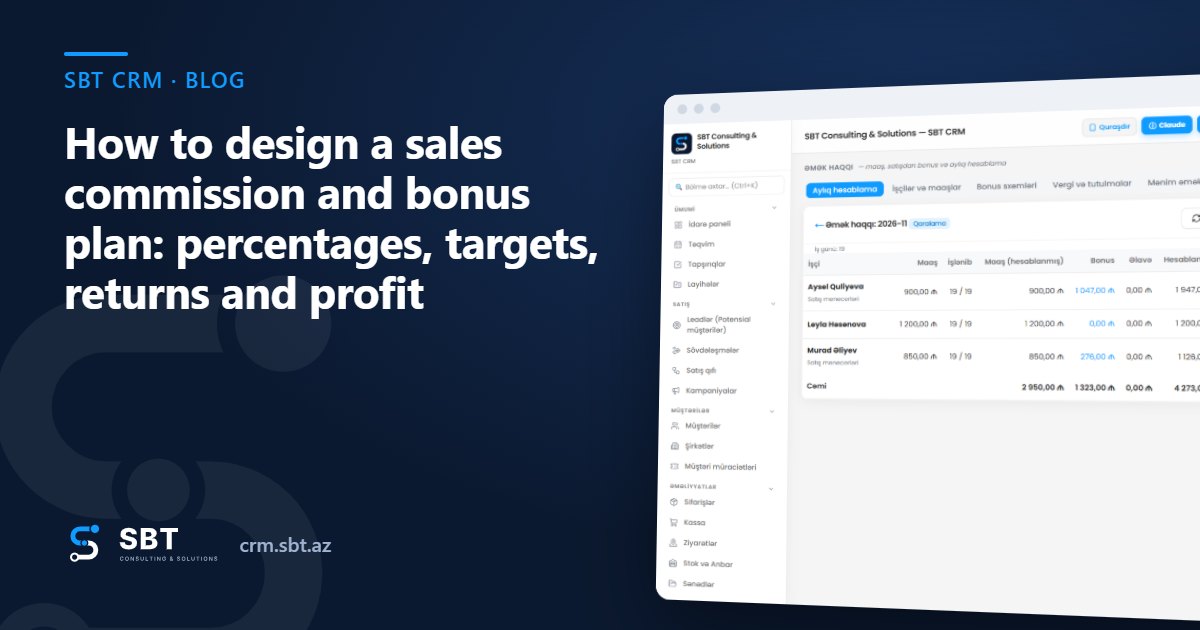
The Payroll section in SBT CRM calculates base salaries and sales bonuses in one place. On the "Bonus schemes" tab you can create any number of schemes. For each rule you choose bonus or deduction, the calculation (percent, tiered percent, when the target is met, per unit, fixed amount), the base (sales, sales before returns, returns, profit, payments received, deals won, new customers) and whose results count (own customers, own sales, team, whole company). Bonuses use the same sales, returns and profit figures as the P&L report, and the "Test" box shows the result for any employee and month without saving the scheme.
On the "Monthly payroll" tab, salary by days worked, bonus and additions are added up, and taxes and deductions, advances and fines are subtracted. You enter the deduction percentages yourself on the "Taxes & deductions" tab after confirming them with your accountant; the system does not set rates by itself. Clicking the bonus amount shows the breakdown by rule. After "Approve" the sheet is locked and employees see their payslips; once the money is paid you mark it "Paid", and the sheet and bonus breakdown can be downloaded to Excel. On the "My pay" page each employee sees their own bonus rules and this month's bonus forecast, and nobody else's data. The section is available on the Standard, Business and Enterprise plans.
At SBT Consulting & Solutions, we always start bonus projects with one question: what exactly does the company want from its salespeople? Once the answer is clear, the plan stays simple, and setting it up in software and calculating it the same way every month is the easy part.
Frequently asked questions
What percentage should a sales commission be?
There is no universal rate. It depends on your margins, the length of the sales cycle and the share of base salary. First decide how much a salesperson should earn when they hit the target, then work out the rate from that amount and the planned sales.
Is it better to pay commission on sales or on payments received?
If you sell on credit and carry receivables risk, paying on payments received protects cash flow. With prepayment or cash sales, paying on sales is simpler and the difference is small.
How should returns be deducted from the bonus?
The simplest way is to calculate the bonus on sales net of returns. If returns happen often, you can add a deduction rule with a small percentage of the returned amount.
When can bonus rules be changed?
Only from the next period, and only after announcing the change to employees in writing. Changing the rules during the month destroys the team's trust in the plan.